In the disaster movie “Moonfall,”
the moon goes out of orbit and starts coiling its way toward Earth,
causing environmental disasters and setting the clock on humanity.
Scientists calculate ellipses; screenwriters ready their exclamations.
“Everything we thought we knew about the nature of the universe has just
gone out the window,” a N.A.S.A. official (Halle Berry) proclaims. But
for the director Roland Emmerich (“Independence Day,” “The Day After
Tomorrow,” “2012”), who treats the planet to potentially life-ending
cataclysms with the regularity of dental checkups, it’s not much new
under the sun.
To learn more, Berry’s
character, Jocinda, visits a restricted N.A.S.A. compound, where Donald
Sutherland, as the staff deep-secrets keeper, appears to have been
waiting, growing his hair long and listening to Mahler with a gun ready.
Jocinda will need to team up with Brian (Patrick Wilson), an
ex-astronaut who hates her after the fallout from an accident years
earlier. Their moonshot to save the world, carried out as a rogue
mission while the authorities stupidly ready their nukes, will involve
traveling through space without electricity. Their seatmate — a
fringe-science guy (John Bradley) whose mantra is “what would Elon do?” —
should probably turn off his smartphone.
This
off-world adventure flirts with the transcendently goofy, but Emmerich
spoils it by crosscutting to a useless narrative thread on Earth, where
Brian and Jocinda’s sons (Charlie Plummer and Zayn Maloney) have been
thrown together to seek safety in Colorado, for reasons that make as
little sense as anything else. (Hearing that the planet is on the brink,
Michael Peña, as Brian’s ex-wife’s current husband, announces, “We
should go to Aspen.”)
President Biden
said the attack on Abu Ibrahim al-Hashimi al-Qurayshi was designed to
minimize civilian casualties, but then the terrorist leader set off a
bomb.
Video
transcript
0:00/1:55
ISIS Leader Kills Himself With a Bomb During U.S. Raid in Syria
President
Biden said the leader of the Islamic State died during a raid by U.S.
Special Operation forces. All of the American troops returned safely
from the operation, he said.
Knowing
that this terrorist had chosen to surround himself with families,
including children, we made a choice to pursue a special forces raid at a
much greater risk than to our own people, rather than targeting him
with an airstrike. We made this choice to minimize civilian casualties.
This operation is testament to America’s reach and capability to take
out terrorist threats, no matter where they try to hide anywhere in the
world.
President
Biden said the leader of the Islamic State died during a raid by U.S.
Special Operation forces. All of the American troops returned safely
from the operation, he said.CreditCredit...Mohamed Aldaher, via Reuters
A
risky predawn raid by U.S. Special Operations forces that resulted in
the death of the Islamic State’s leader on Thursday was set in motion
months ago with a tip that the top terrorist was hiding out on the top
floor of a house in northwest Syria.
In
brief remarks at the White House, President Biden said the decision to
send about two dozen helicopter-borne commandos to capture or kill the
leader, Abu Ibrahim al-Hashimi al-Qurayshi, was made to minimize the
risk of civilian harm. Military officials said attacking with a bomb or a
missile would have been safer for the troops but could have endangered
more than a dozen civilians in the house, including several children.
“We
made a choice to pursue a Special Forces raid, at a much greater risk
than our — to our own people, rather than targeting him with an
airstrike,” Mr. Biden said. “We made this choice to minimize civilian
casualties.”
Aides said Mr. Biden had
approved the raid on Tuesday morning after months of military planning,
including dozens of rehearsals and an exercise involving a tabletop
model of the building. On Thursday, he called the operation a warning to
all terrorist groups. “This operation is testament to America’s reach
and capability to take out terrorist threats no matter where they try to
hide anywhere in the world,” he said.
Investors are snapping up shares of Snap Inc. after the owner of
the disappearing message platform Snapchat surprised Wall Street by
posting a quarterly profit for the first time.
The stock jump
came Thursday after Facebook parent Meta saw its worst one-day stock
price decline in its history, showing that while internet and social
media companies are sometimes lumped together by Wall Street, their
fortunes often diverge.
Shares of Snap Inc. were up $14.30, or
58%, to $38.89 in after-hours trading. The stock, which tends to be
volatile, lost nearly 24% in the regular trading session following
Meta’s plunge.
“Snapchat is clearly not as prone to the ‘TikTok
effect’ as Meta, with strong daily active user growth in all regions,
including North America,” said Insider Intelligence analyst Jasmine
Enberg. She referred to the decline in user growth at Facebook that is
in large part due to competition from TikTok, the popular video sharing
app.
Even so, Enberg added, much of Snap’s growth likely came from India, where TikTok is banned.
Snap,
which is based in Santa Monica, California, said Thursday its
fourth-quarter profit was $22.6 million, or 1 cent per share, compared
to a loss of $69 million, or 8 cents per share, a year earlier. Analysts
had been expecting it to report a loss of 9 cents a share in the latest
quarter, according to FactSet.
Revenue grew 42% to $1.3 billion.
Snap’s average daily user count also continued to increase, up 20%
year-over-year to 319 million in the fourth quarter.
__
This story has been corrected to use the accurate pronoun of analyst Jasmine Endberg.
Sports Desk, Feb 3 (EFE).- Athletic Club nipped Real Madrid 1-0
Thursday in their Copa del Rey quarterfinal, putting an end to the
LaLiga leaders’ hopes of the domestic double and sustaining their own
quest for a 24th title in the competition.
The celebration in Bilbao followed a crushing defeat for Basque derby
rivals Real Sebastian at the hands of Real Betis in Thursday’s other
quarterfinal.
Real Madrid prevailed 2-0 over Athletic Jan. 16 in the Spanish
Supercup final in Saudi Arabia, but the author of one of the Blancos’
goals in that game, Karim Benzema, was out of the squad for the Copa del
Rey tie due to injury.
The initiative belonged to the hosts during the first half at San
Mames, winning six corners, and Dani Garcia tested Real Madrid
goalkeeper Thibaut Courtois with a blast from close range.
Even so, the sides went to the dressing rooms knotted 0-0.
Athletic kept up the pressure and Courtois had to be sharp to deny
Iñigo Martinez early in the second half, but as the match wore on, the
home team began to pay the price for the frenetic pace and the run of
play tilted in Real Madrid’s favor.
Yet the Blancos failed to take advantage of the shift and with a
minute left in regulation, Athletic’s Mikel Vesga intercepted a pass out
from the back and relayed the ball to Alex Berenguer, who bested
Courtois with a shot just inside the far post.
Isco Alarcon missed the net on an opportunity for the equalizer in
the 94th minute and Athletic grabbed the semifinal berth after knocking
off holders Barcelona and mighty Real Madrid in succession.
The jubilation in Bilbao was a stark contract from the somber mood
101 km (60 mi) east in San Sebastian, where Sociedad fans saw their team
eliminated from the Copa del Rey by Betis for the third time in four
seasons.
To make matters worse, a pair of former Sociedad players accounted
for three of the visitors’ four goals. Juanmi scored 12 minutes into
each half to make it 2-0 for Betis and Willian Jose converted a penalty
in the 83rd minute.
Aitor Ruibal added a fourth goal with three minutes remaining in regulation.
Sociedad looked to have equalized just before half-time when Adnan
Januzaj hammered in a David Silva cross, but the goal was disallowed for
an offside.
Valencia, an eight-time Copa del Rey winner, and surprising Rayo Vallecano clinched semifinal berths on Wednesday. EFE ro-cr/dr
After saying that it could have no operating profit at all in the
fourth quarter, Amazon tops $14 billion in net income, with a huge chunk
coming from investment in Rivian electric-vehicle startup
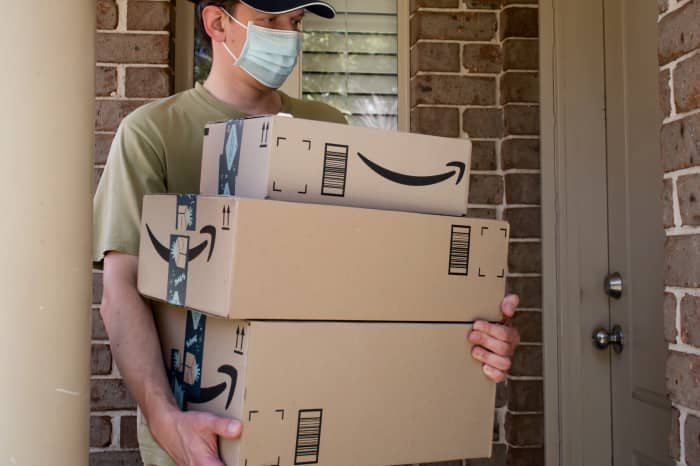
Amazon.com Inc. reported holiday-quarter earnings on Thursday.
This feature is powered by text-to-speech technology. Want to see it on more articles? Give your feedback below or email audiofeedback@marketwatch.com.
Amazon.com Inc. executives thought that supply-chain and staffing concerns could wipe away their holiday profit.
They were wrong.
Amazon
AMZN,
-7.81%
reported fourth-quarter profit of $14.3 billion, or $27.75 a
share, after reaping earnings of $11.73 a share in the holiday season a
year ago, with $11.8 billion attributed to the company’s investment in
Rivian Automotive Inc.
RIVN,
-6.16%,which went public in the quarter. Sales grew to $137.4 billion from $125.56 billion the year before, a then-record total that Amazon surpassed in Thursday’s report.
Analysts on average expected Amazon to report $3.61 in earnings — despite a forecast that said a break-even quarter from an operating standpoint was possible
— on sales of $137.68 billion, according to FactSet. Shares jumped more
than 14% in after-hours trading following release of the results, after
closing with a 7.8% decline at $2,776.91.
“As expected over the
holidays, we saw higher costs driven by labor supply shortages and
inflationary pressures, and these issues persisted into the first
quarter due to omicron. Despite these short-term challenges, we continue
to feel optimistic and excited about the business as we emerge from the
pandemic,” Chief Executive Andy Jassy said in a statement included with
the results Thursday. Jassy was announced as the successor to Amazon co-founder Jeff Bezos a year ago, when Amazon revealed its 2020 holiday performance.
Amazon
predicted it could struggle for profit in the holiday season because of
immense spending tied to supply-chain and staffing issues as well as
the company’s attempt to improve Prime delivery service times, but beat
the top end of its forecast range with $3.5 billion in operating profit.
That does not mean Amazon didn’t spend as expected — cost of sales
increased more than $3 billion, to $82.84 billion from $79.24 billion a
year ago, while fulfillment costs rose to $22.45 billion from $18.74
billion. Those costs are expected to be an issue moving forward as well.
“We
find it hard to imagine Amazon escaped the incremental cost inflation
leading up to Christmas, and expect those pressures, along with Amazon’s
penchant to invest for future growth, to weigh on profit through at
least [the first half of the year], strength in AWS and advertising
notwithstanding,” Benchmark analyst Daniel Kurnos wrote in a preview of
the report, while forecasting an operating loss for Amazon’s holiday
season but maintaining a “buy” rating and $4,000 price target.
Amazon
also announced that it will increase the price of its Prime
subscription service as it attempts to speed delivery for those
subscribers, the first increase in the price in nearly four years.
Subscribers will pay $139 a year, or $14.99 a month, for the service,
which was previously $119 a year, or $12.99 a month, an increase that
takes effect for new subscribers Feb. 18 and renewals as of March 24.
Amazon’s
cloud-computing division, Amazon Web Services, or AWS, continued to be
the biggest profit driver for Amazon. Amazon reported AWS operating
profit of $5.29 billion on revenue of $17.78 billion; analysts on
average were expecting operating profit of $4.84 billion on sales of
$17.38 billion, according to FactSet.
AWS’s
operating profit was greater than Amazon’s $3.5 billion total as a
whole because the core e-commerce business was unprofitable, especially
outside the U.S. Amazon reported an operating loss of $206 million on
sales of $82.36 billion in the U.S., and an operating profit/loss of
$1.63 billion on sales of $37.27 billion internationally during the
holiday season.
Amazon for the first time Thursday showed off the
performance of one of its fastest growing businesses, advertising.
Amazon’s ad business has been growing for years, as merchants who sell
on the company’s e-commerce platform pay to get their goods higher in
search results, leading to competition with online-ad titans Alphabet
Inc.’s Google
GOOGL,
-3.32%GOOG,
-3.64%
and Facebook Inc.
FB,
-26.39%
Amazon had included advertising revenue with some other businesses before breaking it out Thursday.
“We
have looked at the proportion of other revenue that [was] advertising
services and we got to a point where I did pretty much mention every
quarter the majority of that line item was advertising revenue, and [it
reached] a certain size that we should break it out and split the other
off of that,” Chief Financial Officer Brian Olsavsky said when asked by
an analyst why Amazon began reporting ad revenue.
Amazon
disclosed quarterly advertising revenue of $9.72 billion over the
holidays, up 32% from a year ago and 27% sequentially. For the full
year, Amazon recorded ad revenue of more than $31 billion, more than the
annual revenue from Google’s YouTube ($28.85 billion) and more than 4.5
times the annual revenue total of Snap Inc.
SNAP,
-23.60%
and Pinterest Inc.
PINS,
-10.32%
combined.
For the fiscal first quarter, Amazon
executives forecast operating profit of $3 billion to $6 billion on net
revenue of $112 billion to $117 billion. Analysts on average were
expecting operating profit of $6.4 billion on net sales of $120.94
billion, according to FactSet.
Amazon stock has struggled since
executives predicted the holiday season may not be that profitable in
its previous earnings report, falling more than 17% in the past three
months as the S&P 500 index
SPX,
-2.44%
declined 1.5%
Lifestyle inflation tempts people to spend money to solve their problems. You can afford to throw out pants with holes in them, so why fix them? For starters, you miss out on learning useful skills.
As personal finance blog Pretend to Be Poor explains, when you're broke, you have to find creative solutions to problems that often require learning new skills. When your clothes rip, fixing them is cheaper than buying new ones. When your apartment is tiny, you find new ways to conserve space. Learn to fold your clothes more efficiently, rather than buy bigger luggage. Many problems can be solved by buying something that fixes it for you, but those things won't teach you new skills:
Some people feel excited when they find the next new product that will make their life easier. Don't get me wrong, I love my microwave and dishwasher. But others seek accomplishment in spending less, and this often results in becoming more useful. For example, I love Indian food, but I don't love spending money at restaurants. So I'm learning to make Indian food. Neil enjoys riding his bike because it's free exercise and saves on transportation costs. For both of us these money-saving measures are enjoyable in part because we feel accomplished after a challenge.
Finding a DIY solution isn't always about finding the most cost-effective way of doing something. Indeed, some things may never be worth the effort. However, in many cases, the skills you can learn by trying to do something the cheap way can be far more worthwhile in the long run, not just to your budget, but to making you a more useful, capable person in general.